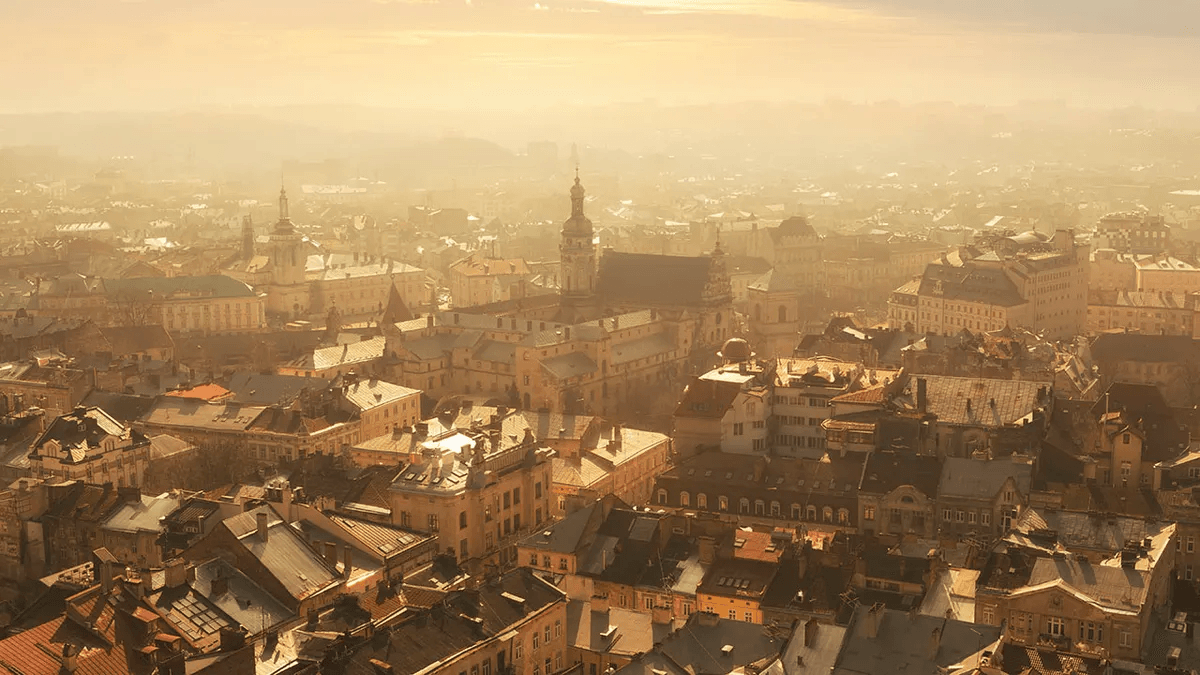
Between 20–21 January, Lviv’s social media were full of discussions about a sharp smell in the air, haze over the city, and a feeling of heaviness when breathing. For many residents this seemed like a sudden and unique event, but similar episodes have been observed in Lviv for several years already and are typical of large cities in the region during winter. A similar situation occurs in Kyiv, Kraków and other cities of Central and Eastern Europe, where stagnant weather combined with intensive emissions leads to smog episodes.
These pollution factors cannot be changed quickly, so the city’s task is to systematically reduce emissions, adapt transport and energy infrastructure, and take weather forecasts into account when planning urban policy.
Sources of pollution and the city’s response
One of the main sources of air pollution in the city is road transport. During rush hours, Lviv’s central streets are heavily congested with vehicles with internal combustion engines. In traffic jams, engines run at low speeds, emitting carbon monoxide, volatile organic compounds and fine particulate matter. In calm weather, these pollutants accumulate between buildings and above roadways. This is why residents notice poorer air quality along busy arterial roads and in the city centre.
The city is trying to respond to these factors. Dedicated public transport lanes have been introduced, streets are being reorganised to reduce congestion, and work is underway to launch a municipal bike-sharing system. Another important area is the development of green infrastructure: creating a green framework for the city, forming green corridors, increasing tree planting along streets, and integrating greenery into cycling and pedestrian projects.
A second important source of winter pollution has been autonomous power supply units — primarily diesel and petrol generators. They are used during power outages near offices, shops and service-sector businesses.
In response, the city is promoting alternative approaches to backup power. In particular, it supports the installation of rooftop solar panels and battery storage systems on municipal buildings and in the residential sector.
A third significant source of pollution is related to heating systems. Some residential buildings in Lviv, especially in private housing areas and historic neighbourhoods, use individual heating — from gas boilers to solid-fuel systems. Burning coal, firewood, briquettes and sometimes low-quality fuels leads to the formation of fine particulate matter, soot, and nitrogen and sulphur oxides.
As an alternative, within the district heating system, the city is exploring solutions based on green alternatives — for example, heat pumps, the use of low-temperature waste heat (such as wastewater heat), and a gradual transition to more sustainable energy sources.
Other factors: terrain, weather, urban form
On 20–21 January, a stable anticyclone formed over western Ukraine, including Lviv. This type of synoptic situation is characterised by high atmospheric pressure, no precipitation, and very weak wind or its complete absence. Under such conditions, the mixing of air masses is significantly reduced, and all pollutants emitted within the city accumulate near the ground and almost do not disperse during the day.
In winter, anticyclonic conditions are often combined with temperature inversion. Under normal conditions, air near the ground is warmer and rises upward, carrying pollutants into higher layers of the atmosphere. During an inversion, the opposite happens: cold, dense air with pollutants accumulates near the surface, while a layer of warmer air forms above it. This stagnant layer blocks the natural ventilation of the city, and pollutants remain close to the surface — exactly at human breathing level.
Lviv’s topography further reinforces these processes. The city lies within the Lviv Basin, and its central part is located in the valley of the Poltva River, surrounded by the hills of the Roztocze range. These include, in particular, Castle Hill, Kortumova Hill, the Citadel and other hills that form a natural barrier for air masses. On cold, calm nights, cold air flows down the slopes into the lowest points of the terrain and forms “lakes” of cold air, especially in the area of Svobody Avenue and Chornovola Avenue. In such conditions, polluted air is literally trapped in the basin, while dense multi-storey development further complicates its exchange with higher layers of the atmosphere.
Combined with the location of emission sources, this leads to the highest concentrations of pollutants often being recorded in the city centre and in low-lying neighbourhoods.
Data and monitoring
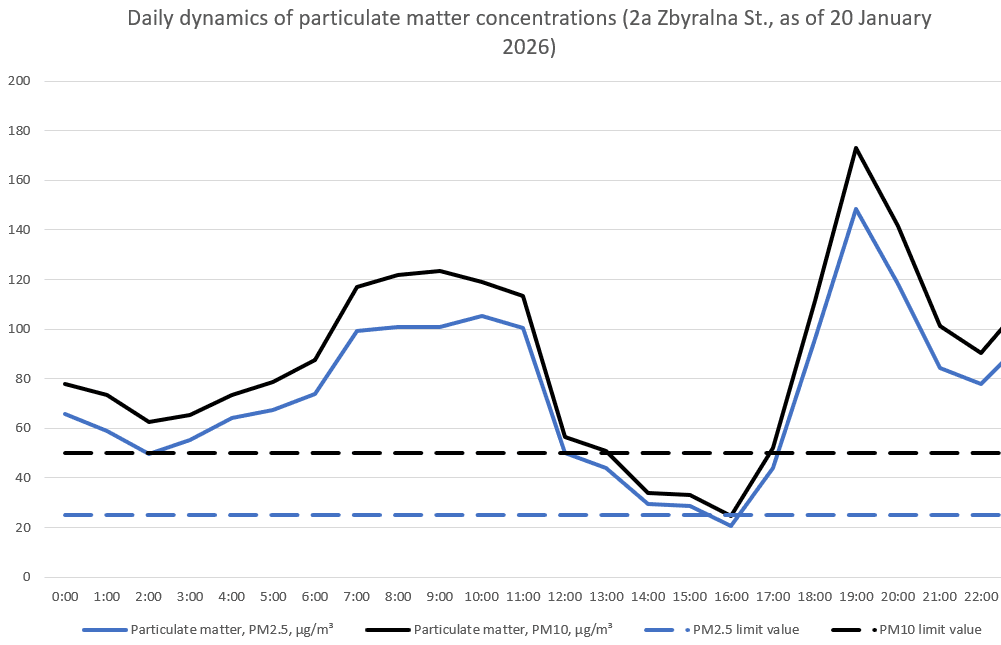
Chart created by Ivan Kukhar based on data from Lviv City Council air quality monitoring stations
The graphs show the daily dynamics of particulate matter concentrations at two monitoring locations operated by the Lviv City Council’s Department of Ecology. In addition to the measured concentrations, they also indicate the limit values recommended by the WHO and set by Directive 2008/50/EC.
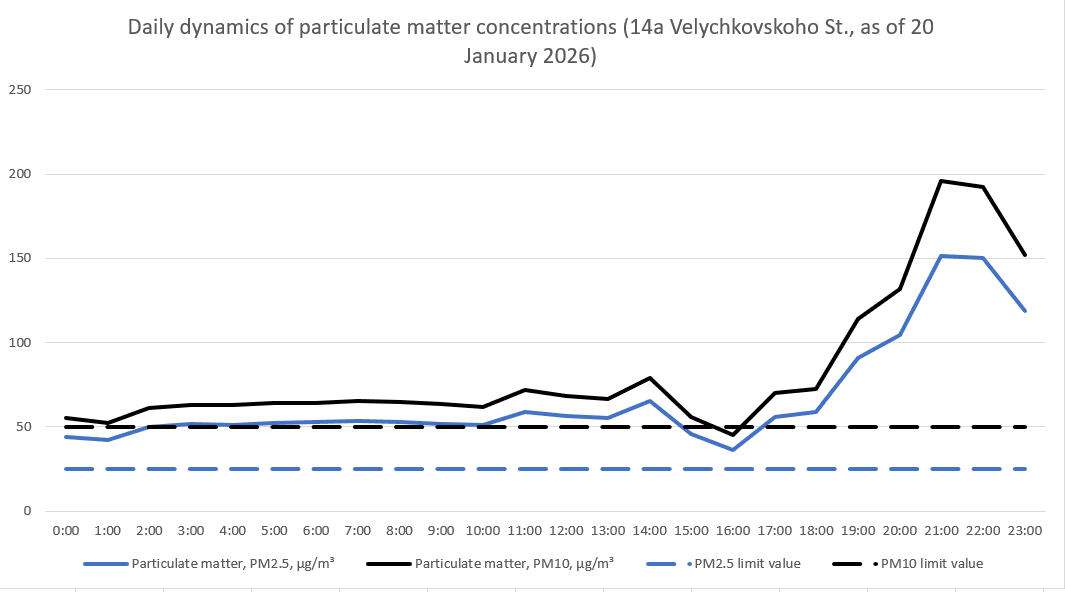
Chart created by Ivan Kukhar based on data from Lviv City Council air quality monitoring stations
A large amount of microscopic particles (PM2.5 and PM10) accumulated in the air. This dust is so fine that it is not trapped in the nasopharynx but penetrates deep into the lungs and even into the bloodstream. For most of the day, the level of this pollution was 2–3 times higher than the norm recommended by the WHO and European directives.
The highest concentrations of these pollutants were recorded:
in the morning (7:00–11:00): when the city wakes up and traffic intensifies;
in the evening (after 18:00): this is the most critical time. At 19:00 on Zbyralna Street, particulate levels spiked to almost six times the recommended limit. On Velychkovskoho Street the situation was even worse — the dirtiest air was recorded there around 21:00.
What residents can do
During periods when elevated concentrations of particulate matter are recorded, residents are advised to limit prolonged stays outdoors as much as possible — especially in the morning from 7:00 to 11:00 and in the evening after 18:00, when monitoring data show the highest levels of pollution.
Ventilation of homes and workplaces is best done at times when pollution is at its lowest. Indoors, people can use air purifiers with filters or, if these are not available, regularly do wet cleaning to reduce dust concentrations in indoor air.
If you have to stay outside for extended periods, it is recommended to use masks that can filter fine particulate matter.
People with chronic respiratory or cardiovascular diseases should discuss an action plan with their doctor in advance for days with high air pollution, have the necessary medications on hand, and carefully monitor their health.